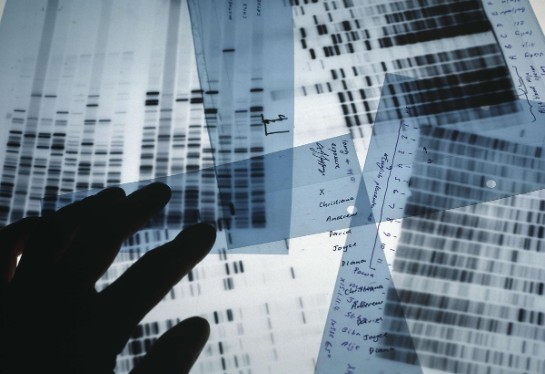
Deoxyribonucleic Acid Profiling Usually ten to thirteen out of the 2000 STR markers are used in DNA profiling. If all STR loci in two DNA samples are found to have identical lengths then this is compelling evidence that they originated from the same person. In humans, the gene amelogenin is expressed on both sex chromosomes but that on the X chromosome is six base pairs shorter than that on the Y. Males express two peaks because they are heterozygous (XY) and females express only one because they are homozygous (XX). An important consideration in DNA profiling would be the ethnic group of the individual because some certain allele combinations will be common among close relatives or ethnic groups but would be rare in a large population. Because STR analysis uses the identification of shorter sequences, it is less vulnerable to problems associated with DNA degradation. This means older samples can be used and analyzed with less problems, and this is not the case with RFLP analysis. The shortness of the STRs mean that only small amounts of DNA are needed. With larger samples, there is more room for impurities, so the shorter the sequence, the less risk there is of this occurring. A common problem with using STRs in DNA profiling is allele dropout. This is when one pair of alleles is not recorded. When this happens, a heterozygous individual may appear to be homozygous at one or more gene loci. This can also occur if the DNA sample is not sufficient to analyze, so DNA profles from degraded or extremely small samples should be treated with caution. |
||
 |
 |
|
